Fundamentals of Drawing
Many of the great artists of the 19th and early 20th century, such as Manet, Degas, and Picasso, were traditionally trained. The 19th century method of teaching artists was to start with drawing of casts and copies of old master drawings and eventually live models. This class follows the first year of this traditional training. Students learn to draw directly from observation working with pencil and charcoal. Techniques such as sighting for proportional relationships, contour line, and shading are explored, with emphasis on the elements of line, shape, value, texture, space, and principles of strong composition. The student will train their eye to see accurate angles and size relationships and subtle differences of line, tone, form, and edges, while attaining a mastery over drawing materials. Instruction will be tailored to individual student levels and needs.
Fundamentals of Painting
This painting course starts with the fundamentals; basic color theory, color mixing, and paint application are explored before moving on to more challenging processes in painting. It introduces the student to both classical and contemporary painting concepts and techniques with an emphasis on painting’s formal language and artistic expression. Instruction will be tailored to individual student levels and needs. Formal language will be explored through painting from observation.
Class Discussion and critiqueThe group discussions will be a regular part of the class and students are welcome to analyze, interpret and talk about their own work and to respond to pieces produced by their fellow class members. This time may also be used as a forum to analyze the work of artists in history and the work of contemporary artists. Instruction will be tailored to individual student levels and needs.
Drawing and Beginning Painting
Many of the great artists of the 19th and early 20th century, such
as Manet, Degas, and Picasso, were traditionally trained. One
method of teaching artists was to start drawing with still lifes,
then drawing with cast figures, gradually transitioning to painting.
This class follows this training. Students learn to draw directly from
observation working with pencil and charcoal and gradually
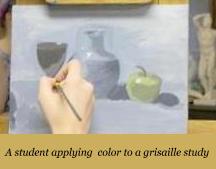
progressing into grisaille painting (gray scale). Colors will be
introduced. Techniques such as sighting for proportional
relationships, contour line, and shading are explored, with
emphasis on the elements of line, shape, value, texture, space,
and principles of strong composition. The student will train their eye to see accurate angles
and size relationships and subtle differences of line, tone, form, and edges, while attaining a mastery over drawing materials including learning how to draw with the brush. Instruction will be tailored to individual student levels and needs.
Classical Painting
Working with still-lifes and live models, the student will learn to paint in the method of the masters of the High Renaissance and Baroque Periods, such as Da Vinci, Titian, Rembrandt, Velazquez, and Vermeer, as well as the masters of the turn of the 20th century such as Sargent, Sorolla, and Repin. The student will train their eye to see and paint the relationship of one color next to another. To quote the great painting teacher, Charles W. Hawthorne,"Real painting is like real music, the correct tones and colors next to each other; the literary and sentimental factors add nothing to its real value." Demonstrations and explanations of painting materials and techniques will be covered, as well as how to create a strong composition, how to represent objects with correct perspective, and how to paint transitions from light to shadow. Instruction will be tailored to individual student levels and needs.
Portrait Painting
This course is an introduction to the basic techniques and methods of working in acrylic and/or oil paint. Students will learn the fundamentals of alla prima (direct), glazing (indirect), color grounds, color mixing, and mixing wet-in-wet. These activities are supported by structured in-class exercises focusing on color, tone, form, composition, and light. We will be painting directly from life, studying the human form and considering format, focal point, lighting, background, expression, and mood. We will explore ways one might use objects, symbols, and gestures to create a contemporary portrait.
High School Portfolio Development
High School Juniors and Seniors may join any classes
in order to work on fulfilling their 2-Dimensional requirements.
Our instructors have worked extensively with High School art
students and offer regular portfolio reviews.